
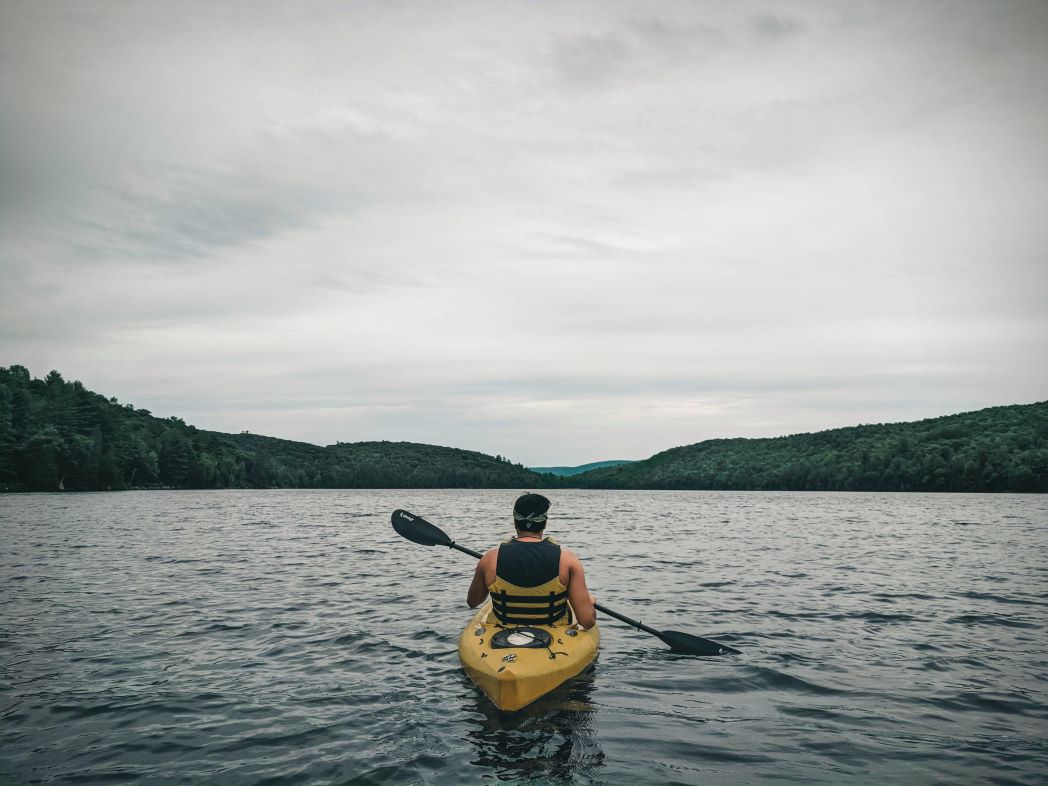
Think of the contrast between a small kayak and a giant oil tanker.
That image alone is enough to understand the power of kayaktivism: a form of water-based activism that uses small boats, such as kayaks and canoes, to protest against environmental destruction and defend threatened ecosystems.
Although the term is relatively recent, the practice dates back to the early 1970s, when activists began using small boats as tools of nonviolent protest. Some of the earliest actions involved canoe blockades targeting U.S. shipments of weapons to Pakistan during the Bangladesh Liberation War. In the decades that followed, San Francisco’s Bay Area Peace Navy adopted similar tactics to protest against militarism, nuclear power, and arms shipments to Central America.
Over time, these actions evolved into a form of environmental activism, increasingly targeting fossil fuel extraction, oil drilling and industrial infrastructure.
Examples include the Pacific Climate Warriors’ 2014 canoe blockade against coal exports in Newcastle, Australia; protests against Shell’s Arctic drilling operations in the northwestern United States in 2015; and river-based demonstrations in New Jersey opposing a proposed power plant and a natural gas pipeline beneath the Delaware River.
In recent years, Charles Latimer, a Canadian environmental activist, has become one of the prominent figures associated with the movement. His first kayak protest took place in 2014, in Quebec’s Saint Lawrence estuary, where activists opposed TransCanada’s plans to build a supertanker port in an area inhabited by beluga whales.
Their objective was to approach a vessel conducting seismic testing, display a protest banner and document the action. Rather than physically stopping the ship, the activists wanted to draw public attention to the environmental risks of the project.
Later that year, the Pacific Climate Warriors’ actions in Newcastle, Australia, further demonstrated the potential of water-based activism. Using traditional canoes, Pacific Islanders staged a protest against coal exports and their contribution to climate change.
Having experienced coastal erosion and rising sea levels in their own communities, they sought to draw attention to the consequences of fossil fuel consumption. Although the protesters were eventually removed from the area, their action delayed a coal carrier and attracted considerable media attention. Inspired by these initiatives, Latimer became involved with the Sea Wolves, a Vancouver-based collective of kayaktivists.
One of the group’s most significant actions took place on 28 October 2017, when dozens of activists gathered in Vancouver’s harbour to oppose the expansion of the Trans Mountain pipeline. The project raised environmental concerns because of its potential to increase the transportation and production of carbon-intensive oil from Canada’s tar sands.
Around 60 kayaktivists gathered around a construction barge, forming what they called a Wall of resistance and temporarily disrupting its operations. The demonstration took place within the traditional territory of the Tsleil-Waututh First Nation, drawing attention to the environmental and social risks posed by fossil fuel infrastructure, as well as the importance of Indigenous rights.
Despite security warnings and police intervention, the protest garnered media attention and showed how collective action could challenge large-scale industrial projects.
For Latimer, the significance of kayaktivism extends beyond the immediate impact of individual demonstrations. Being physically present on the water creates a direct connection between activists and the ecosystems they seek to protect.
Coastlines, mountains, marine wildlife and fragile aquatic habitats are no longer abstract environmental concerns, but living environments that people can experience and appreciate firsthand.
Kayaktivism therefore combines environmental protest, civil resistance and visual communication.
By placing small human-powered boats alongside enormous industrial vessels, activists create a striking contrast that can attract media attention and make complex environmental issues more accessible to the public.
For these reasons, kayaktivism can be particularly effective as a communication strategy. It creates a visual David-and-Goliath narrative, contrasting the vulnerability of small boats with the power of the fossil fuel industry.
It also offers opportunities to produce striking photographs and videos that can spread widely through social media and livestreams. In this way, a local demonstration can gain international exposure, foster public engagement and make complex environmental issues more accessible through compelling visual narratives.
Almost a decade after the Vancouver protests, the questions raised by kayaktivism remain relevant. In 2026, climate activism continues to evolve, combining traditional demonstrations with digital campaigns, direct action and international mobilisation.
Movements such as Fridays for Future continue to organise climate strikes and demonstrations around the world. In 2026, their activities have included a global climate strike in May, mobilisation around the climate conference in Bonn in June, and climate marches in Amsterdam and Brussels in September and October. Other initiatives, such as the Climate Justice Flotilla in the Caribbean, have taken the fight against fossil fuels and extractivism directly onto the water.
At the same time, climate justice campaigns increasingly connect the fight against fossil fuels with Indigenous rights, social inequalities and the protection of local communities.
This reflects a broader understanding of the climate crisis, which is no longer discussed exclusively in terms of emissions. Instead, it increasingly focuses on environmental justice and the unequal distribution of its consequences.
Although kayaktivism represents only one expression of this broader movement, it offers an important lesson in environmental communication: making an issue visible is often the first step towards engaging the public.
Whether through a kayak confronting an oil tanker, a climate march filling city streets or a campaign spreading across social media, environmental activists continue to find creative ways to turn complex global challenges into powerful and accessible messages.
Ultimately, kayaktivism demonstrates that environmental communication is not limited to words, statistics or awareness campaigns. Sometimes, a small boat on the water can tell a story that reaches far beyond the shoreline.