
Is climate change simply another way to say global warming?
In public debate, the two expressions are often treated as interchangeable. A recent study published in Humanities and Social Sciences Communications (Nature Portfolio) suggests that using Climate Change and Global Warming as synonyms is not only inaccurate, but potentially harmful for climate communication.
More than 55,000 articles, published between 2018 and 2025 in three major UK newspapers such as The Guardian, The Independent and The Telegraph, were analyzed. Researchers Yee-man Lam and Benson Shu-yan Lam demonstrate that different climate-related terms are used in systematically different ways.
The study focuses on the following five expressions: climate change, climate crisis, climate emergency, global warming and global heating. Through the use of corpus linguistics (the quantitative study of large text collections) and statistical analysis, the authors demonstrate that these terms are not synonymous.
The term climate change is far more likely to appear in discussions about policy, government action, institutions and urgency. Conversely, global warming is more commonly used in technical or scientific contexts, particularly when referring to temperature thresholds such as the 1.5 °C limit established by the Paris Agreement.
This distinction matters. Language does not merely describe reality; it shapes it. When newspapers use the term climate change, they tend to adopt a systemic perspective, focusing on issues such as governance, responsibility and collective action.
However, when they use global warming, the focus narrows to physical processes such as heat, emissions and measurements. Treating the two terms as interchangeable risks blurring these frames and weakening the clarity of public discourse.
Climate Change has become the language of urgency
Earlier research suggested that the term global warming sounds more alarming. However, the UK media data show the opposite: words expressing urgency, such as urgent or emergency, appear significantly more frequently alongside climate change.
The findings also complicate the idea that political orientation is the sole determinant of word choice. Despite their different editorial leanings, all three newspapers overwhelmingly rely on climate change as the dominant term. Newer expressions such as climate crisis or climate emergency are becoming more common, particularly in The Guardian, but they have not replaced the older vocabulary.
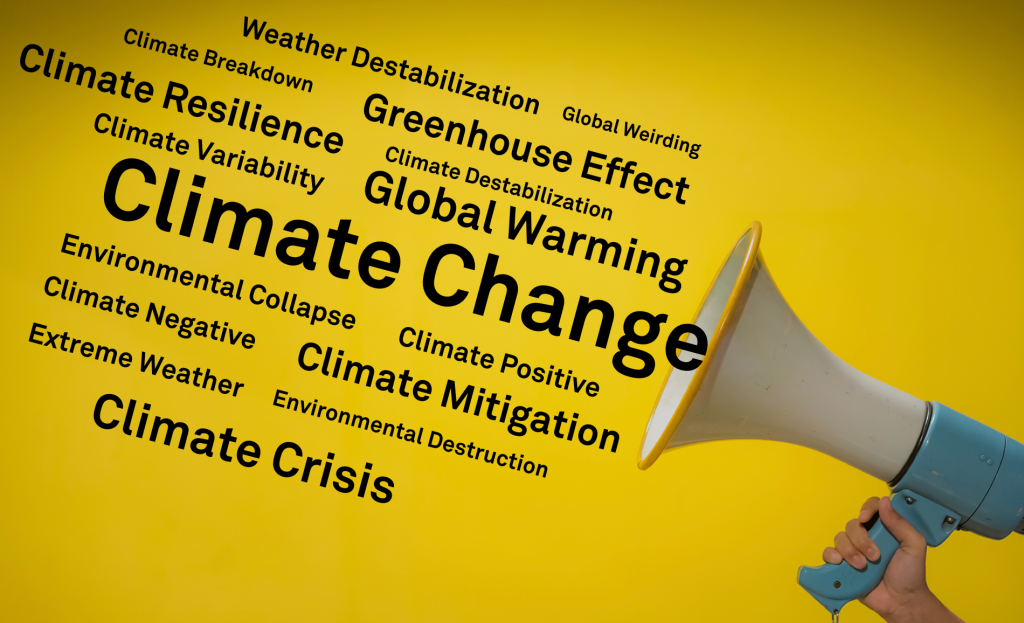
The message is clear: precision in language is not a semantic luxury.
If the aim of climate communication is meant to inform, mobilise and guide policy, then journalists, scientists and institutions should be more deliberate about the words they use. Referring to everything as global warming does not only simplify the issue, but also reshapes how responsibility, urgency and action are understood.